
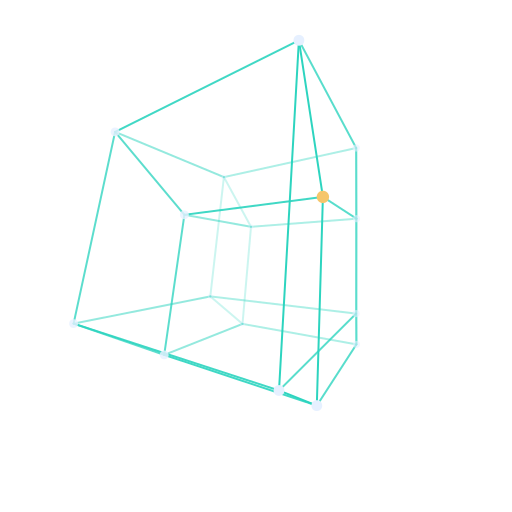
The tesseract, explained
NanoSI is built on one idea: give every fact an address you can check. The tesseract is how we picture that address.
NanoSI³
NanoSI to the power of three
NanoSI³ is how we write the product. Three dimensions have to grow together: Structured, Security, and Super Intelligence.
NanoSI³ = Structured · Security · Super Intelligence
-
Structured
Knowledge lives in an explicit lattice. Every fact has an address you can check, so an answer can be walked back to its source.
-
Security
Capability without control is a liability. Audit trails, source limits, and human authority are designed to stay in the loop — so stronger models do not mean weaker oversight.
-
Super Intelligence
The long research horizon: more capable systems whose power rests on structure you can inspect, not on a bigger black box. This is a research direction, not a near-term product claim.
The tesseract is how we picture the Structured dimension. NanoSI³ is the product that pairs that structure with Security and with the Super Intelligence horizon.
In 30 seconds
Why a tesseract?
Every fact has an address you can check. The tesseract is how we picture an address for every fact.
In 3 minutes
Why the shape rotates.
The animation shows its shadow in 3D. As it turns, the “inner” cube becomes the “outer” one. That is a good metaphor for the product: one body of knowledge, viewed from different angles. It’s the same facts, still connected.
Why it matters to a business.
- Audit: any answer can be walked back to the lines of the documents behind it.
- Honesty: if a fact isn’t in the lattice, the right answer is “not supported”, not a guess.
Why not just a bigger model?
NanoSI keeps facts where each one can be traced. An answer that is not supported stays unsupported.
Smaller, well-trained models can beat larger ones on a defined task. The sources we point to are Hoffmann et al., Training Compute-Optimal Large Language Models (Chinchilla) (external), Ouyang et al., InstructGPT (external), and the SmolLM3 model card (external).
Every answer links back to its sources.
Measurement and known limits
Known limits
- Results depend on document quality, lattice completeness and domain.
- The lattice can only verify what it contains.
- No guaranteed performance level.
Pilots and deployment
Planned deployment options: cloud, your cloud, on-premise, air-gapped.